


Read the full series: Part One - Part Two - Part Three
A remarkable winter solstice sunrise phenomenon at the Pre-Pottery Neolithic site of Karahan Tepe (9400 BC - 8200 BC) was discovered by the authors of this article in December 2021.1 Known as the sister site to Göbekli Tepe, and part of the Taş Tepeler (Stone Hills) project, it is located in the Tektek Mountain, some 20 miles southeast of Şanlıurfa, Turkey. Karahan Tepe was first discovered in 1997 by Bahattin Çelik with excavation beginning in 2019. Hunter-gatherers constructed large stone circular structures, sunken bedrock pits and hundreds of T-shaped pillars and intricate statues.
This unique winter solstice discovery may be the oldest solstice alignment built into a megalithic site on the planet (being 7000 years older than Stonehenge’s summer solstice). However, it has recently been claimed that the ancient builders had little interest in astronomy and that a roof may have blocked any such alignment.2 The authors stand by their findings as new 3D reconstructions and astronomical data reveal how well it worked in ancient times, even with a hypothetical roof.
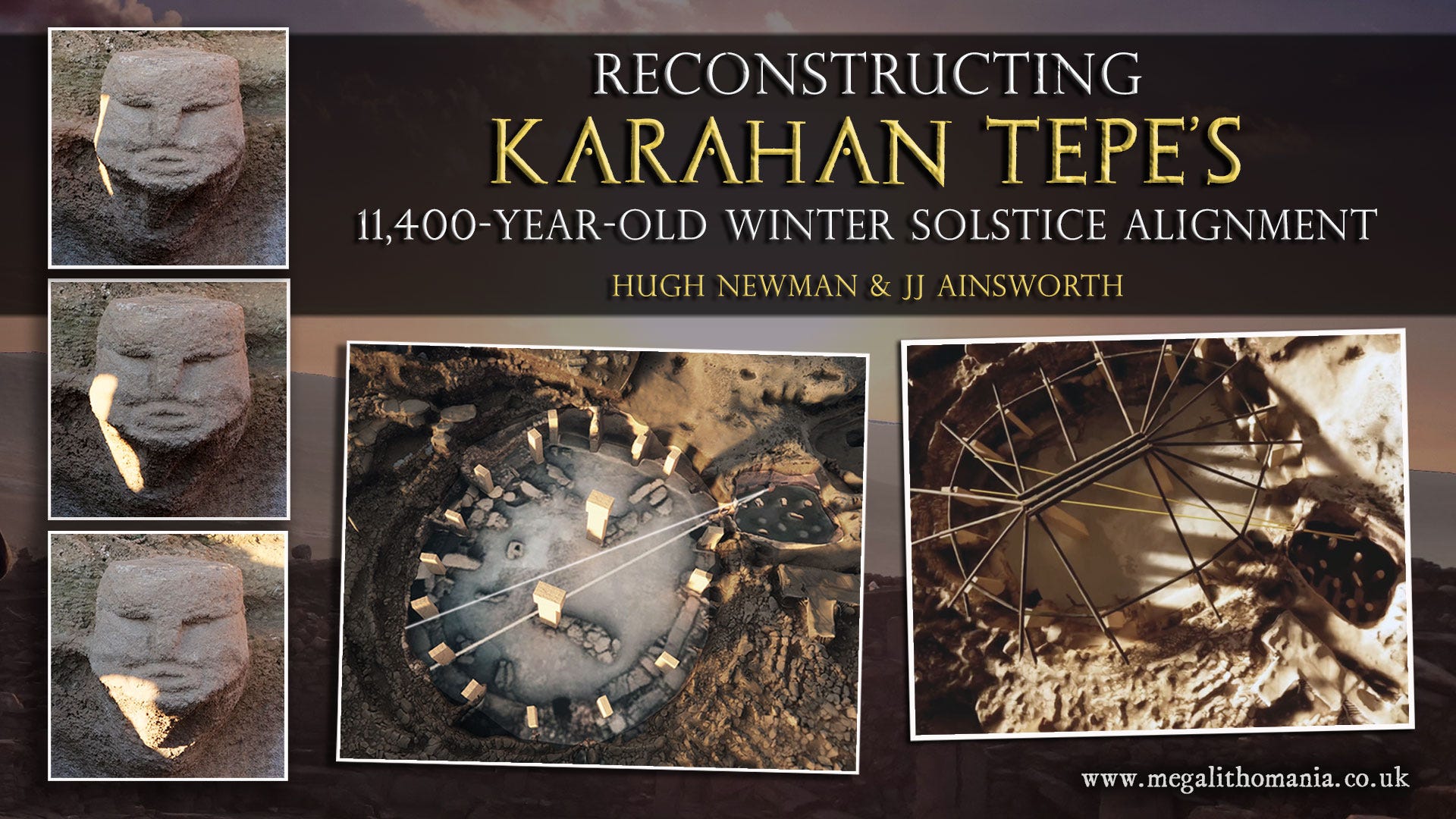
On December 20th 2021 at 7.37am, the sun rose over the rocky hills on the southeastern horizon at Karahan Tepe. Ten minutes later an upright blade of light appeared on one side of the oversized stone head protruding from the western wall of Structure AB (a sunken pit with 11 upright pillars, also known as the Pillars Shrine). The suns rays were beaming through a bedrock porthole to the southeast (which leads into Structure AD, a 75ft wide enclosure). The slim shard of light slowly moved across the face widening and descending to the area of the mouth and neck over a period of 45 minutes as the sun rose in the sky. This was clearly a deliberate alignment built into the structure to record this phenomenon, and we feverishly documented it to the best of our ability.
On a subsequent visit in December 2022, this time with author Andrew Collins and some Turkish colleagues, the site was investigated on three consecutive mornings to record the phenomenon in more detail, which included taking accurate orientations of the sunrise and using time-lapse photography to capture the the process in detail.
In our previous series of articles, and in the appendix of Andrew Collins’ book Karahan Tepe,3 we presented our analysis of the findings which utilised the astronomy software called Stellarium backdating the alignment to the time of Karahan Tepe. We chose the date of 9000 BC, as the site was in used from 9400 BC to 8200 BC and felt this was a good choice to focus our research on, yet still, even a few hundred years before or after this would not affect the results. We concluded that at this time the phenomenon would not only have still functioned effectively, but would have illuminated the stone head more completely due to the slightly different position of sunrise in 9000 BC due to the ‘obliquity of the ecliptic’.
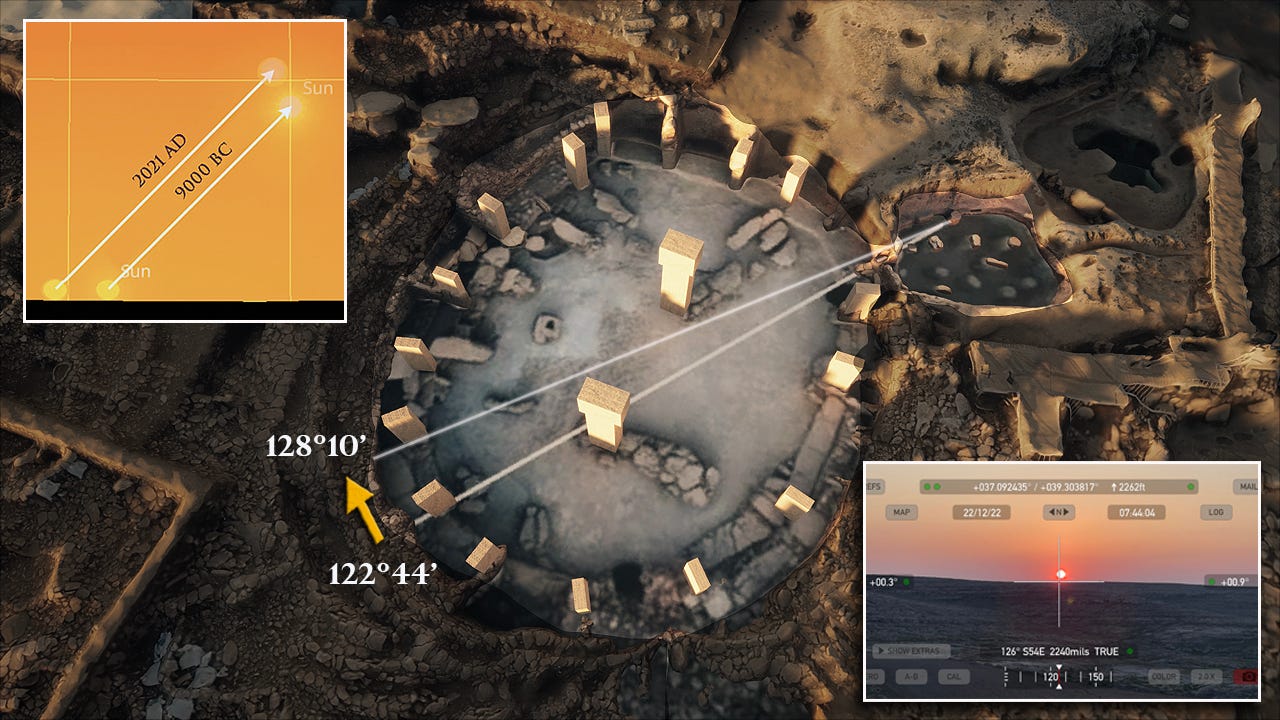
On the winter solstice in 9000 BC the sunrise would have been at 7.57am; this is an azimuth 121º1’. Ten minutes later at 8.07am the sun would reach 122º44’ azimuth, and altitude 2º when it would start illuminating the stone head. This would continue, as it does in the current era, for about 45 minutes. This takes into account refraction for a temperature of 15º celsius. To summarise, the sun would appear just over one degree to the right (south on the horizon) compared to where the sun is located today (due to the change in the ecliptic).
The sun, on the winter solstice, reaches its most southerly sunrise position on the horizon and appears to rise in approximately the same position for a few days. Solstice means the ‘standstill of the sun’. It is on 24th or 25th December that the sun starts slowing rising in a more northerly position away from the extreme winter solstice position. When this starts happening, the phenomenon stops working in Structure AB, and will only happen again one year later.
Due to this being a directly observable phenomenon, which can be witnessed by anyone choosing to do so over a few mornings during the period of the winter solstice, it is uncontentious. This is an astronomical fact that happens every year and is built into the site in bedrock. No T-shaped pillars, or movable monoliths are involved. The plausibility of this phenomenon is its simplicity and permanence.
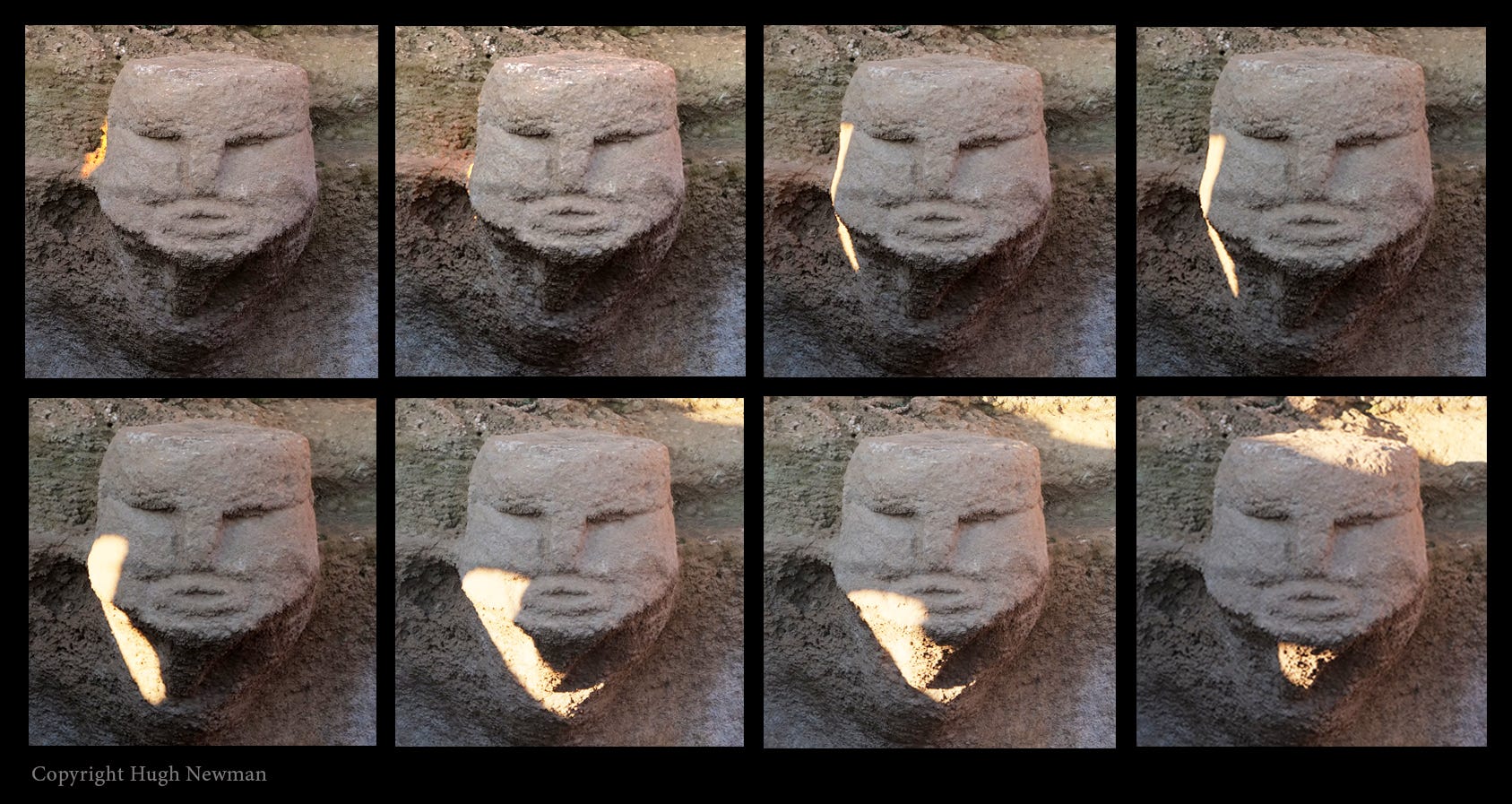
Necmi Karul, the head archaeologist at Karahan Tepe, wrote a paper detailing the extremely careful burying of Structure AB and the porthole, although much of the rest of the site was partly destroyed before being buried.4 This heavily suggests this was the most important area to be preserved. Karul also noted that the stone head’s eyes “looks to the entrance”5 meaning towards the porthole stone, as though the eyes were carved to show it looking through the hole towards the winter solstice sunrise.
Independently of our discovery, Dr Martin Sweatman of Edinburgh University, worked on a paper looking at a potential lunisolar calendar centred on Structure AB at Karahan Tepe.6 We mentioned his hypothesis in our previous articles.7 Since then, in July 2024, his paper was peer-reviewed and published in Time and Mind Journal. The reason we are bringing this back into the spotlight is because his paper received worldwide acclaim and may prove to correlate with our discovery, by giving his lunisolar calendar a start date - the winter solstice.
The midwinter solar alignment is highly likely to have been the observable annual time-marker that restarted this calendar every year. The authors spoke directly to Sweatman in May 2024 at the Megalithomania Conference in Glastonbury about our discovery and how it may fit in with his hypothesis, but he believed it may not work because Structure AD ‘probably had a roof’. This was not the first time this roof hypothesis had come up, so we examined the idea carefully with a civil engineer who has investigated both sites, and a 3D graphic artist using a 3D reconstruction of Karahan Tepe with and without a roof to see if it would affect the illumination of the stone head on the winter solstice.
The Roof Hypothesis: Pseudoscience or Reality?
In our previous articles we looked at other ancient structures around the world, including Newgrange in Ireland and Gavrinis in Brittany, all which have winter solstice sunrise alignments marked with thin blades of light being directed into the interior of these megalithic sites. Many of these had permanent stone roofs. But did the Taş Tepeler sites of Turkey have any such coverings over their main enclosures?
In the article called Debunking claims about Göbekli Tepe (2024) Necmi Karul stated: “The structures at Göbekli Tepe are not observatories. We’ve found wooden traces that suggest the site’s structures were roofed, and no astronomical evidence has been found to support the observatory theory.”8 Karul avoided talking about Karahan Tepe, but he certainly knows about the winter solstice alignment. He continued: “We believe that 12,000 years ago, standing stones were used as supports, covered with materials like wood and branches… We cannot say they did not observe the sky. However, there is no archaeological evidence of this.”
There is also no evidence for wooden roofs over the main enclosures, yet the archaeologists continue with this faulty narrative. The ‘wooden traces’ Karul talks of are in fact remnants of burnt charcoal and two ‘negatives’ where wooden poles may have once existed. These were found in the fill in Enclosure D at Göbekli Tepe in the ‘slope slide’ that Dr Lee Clare discovered,9 and therefore most likely from some of the later, smaller buildings up on the hill above the main enclosures, known to have had small-scale roofs. Also, the negatives are less than two metres in length (and less than 20cm wide) so they match the dimensions of the later buildings, not Enclosure D. We should also ask why haven’t dozens of other ‘negatives’ been recorded in the archaeological layers? Also, no wood and no negatives have been reported at Karahan Tepe.
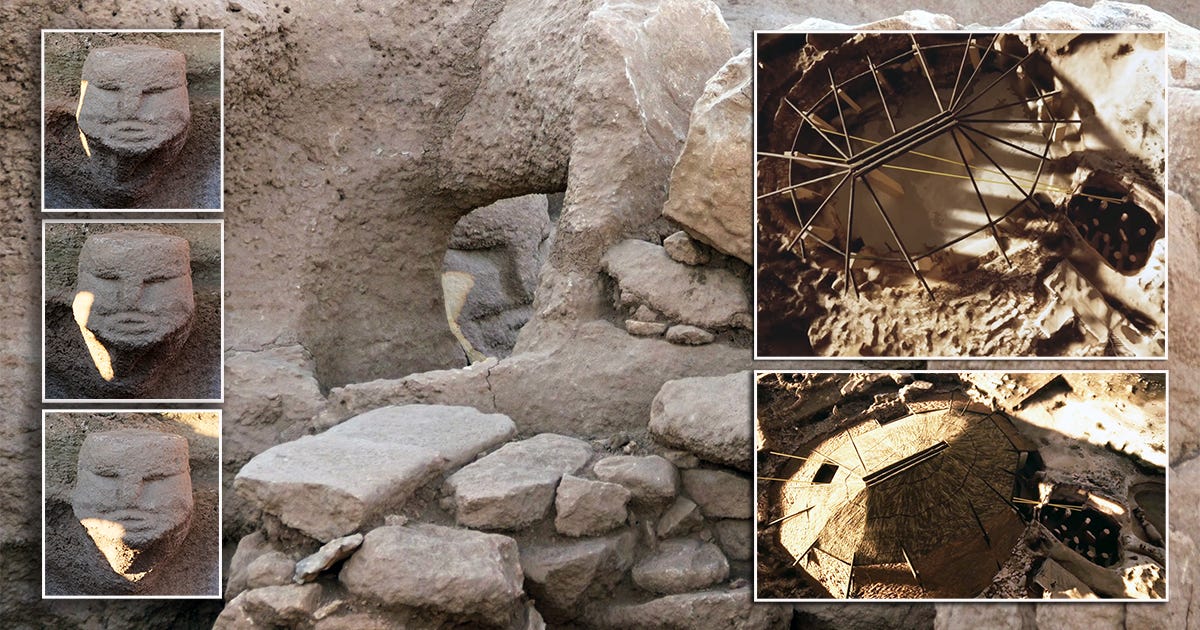
If a permanent roof was required, we should ask why did they not build one into the original design of the sites? At Mnajdra and other sites in Malta the Neolithic people built stone roofs over the top of temples and still accurately recorded the solstices, equinoxes, moon cycles and certain stars on the horizon. The porthole stones and entranceways were their windows into the heavens. The same can be said of Newgrange, Stoney Littleton Long Barrow, Gavrinis, and even Stonehenge, as remarkably, there is a roof hypothesis associated with Britain’s national temple,10 but this is not taken too seriously. Likewise, should we take the roof hypothesis seriously at Karahan Tepe and Göbekli Tepe?
In the 2011 article, So Fair a House: Göbekli Tepe and the Identification of Temples in the Pre-Pottery Neolithic of the Near East,11 archaeologist E. B. Banning, suggests the main enclosures of Göbekli Tepe were elaborate houses, with roofs which he based upon carpentry logistics. His text has been much criticised, including by French archaeologist Prof Rémi Hadad who weighed in on the debate: “The exact form of the roofs has so far been reconstructed only on the basis of a classical carpentry design, where beams connect the peripheral and central pillars in a radial pattern. Given the difference in size between these two points of support, however, this solution seems implausible.”12
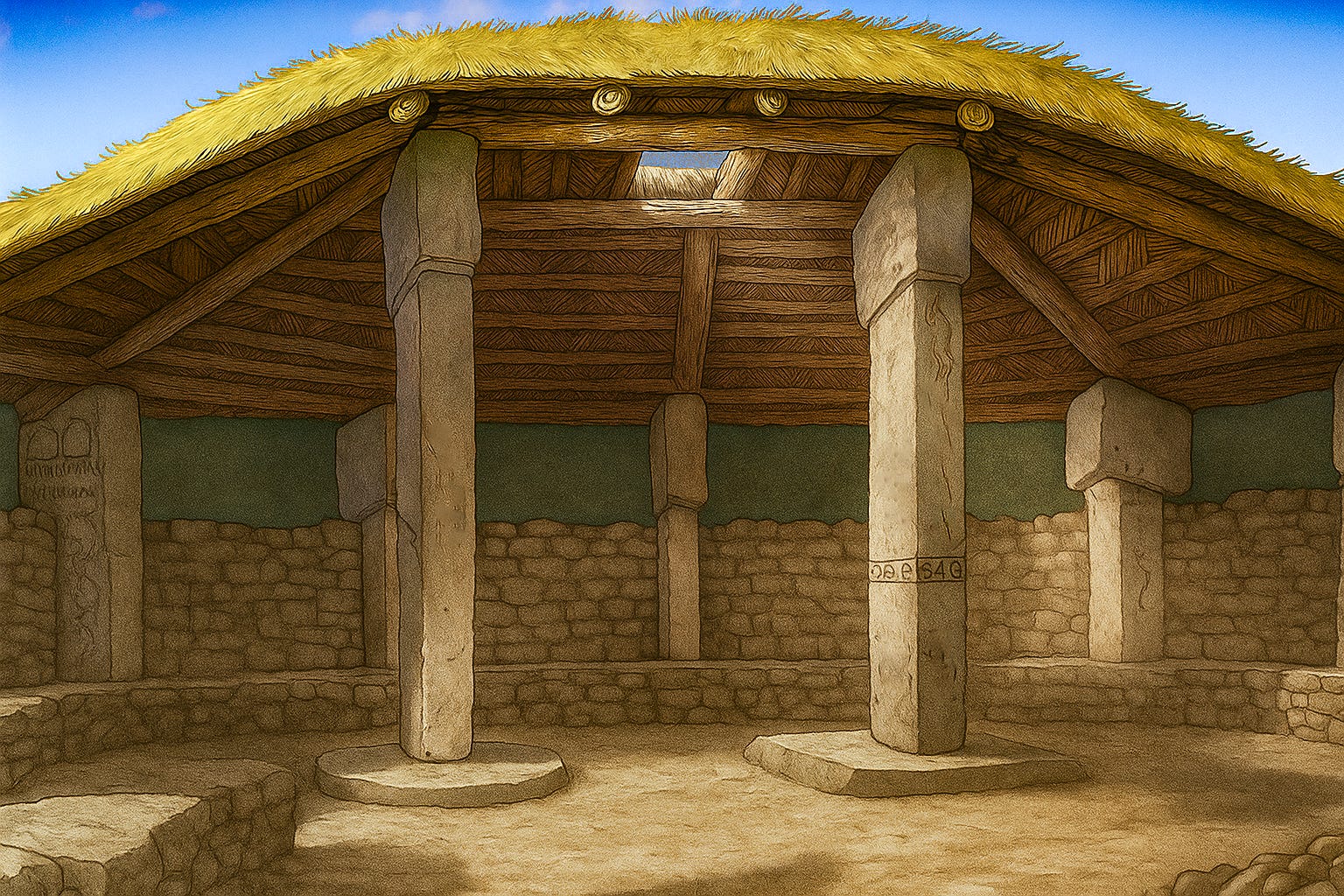
Having the chance to look closely at the interior of Göbekli Tepe in 2013, 2014, and 2015 when low walkways existed between the main enclosures, it was clearly evident that the heights and angles of all the T-pillars were different, and the bases of the central T-pillars were tapered inwards and were balancing in their sockets precariously. This strongly suggests these could have not been used as supports for a heavy roof. Hadad continued: “The stability of the whole structure is dubious because of the irregular disposition of pillars and the difference in level between the periphery and the centre”13 This problem was also commented on by civil engineer Daniel Matthies PE (in a private email): “Given the relative sophistication of the stonework at Göbekli Tepe, I am skeptical that the T-Pillars, with tapered, undersized base dimensions and heavy, oversized horizontal pieces at the top, would be purposed as roof supports. The heavy mass high above the small unstable base is exactly the opposite of what is needed for stability. Turkey is in a very active earthquake zone where lateral stability is important.” Matthies had visited the sites in 2024 before he made these conclusions.
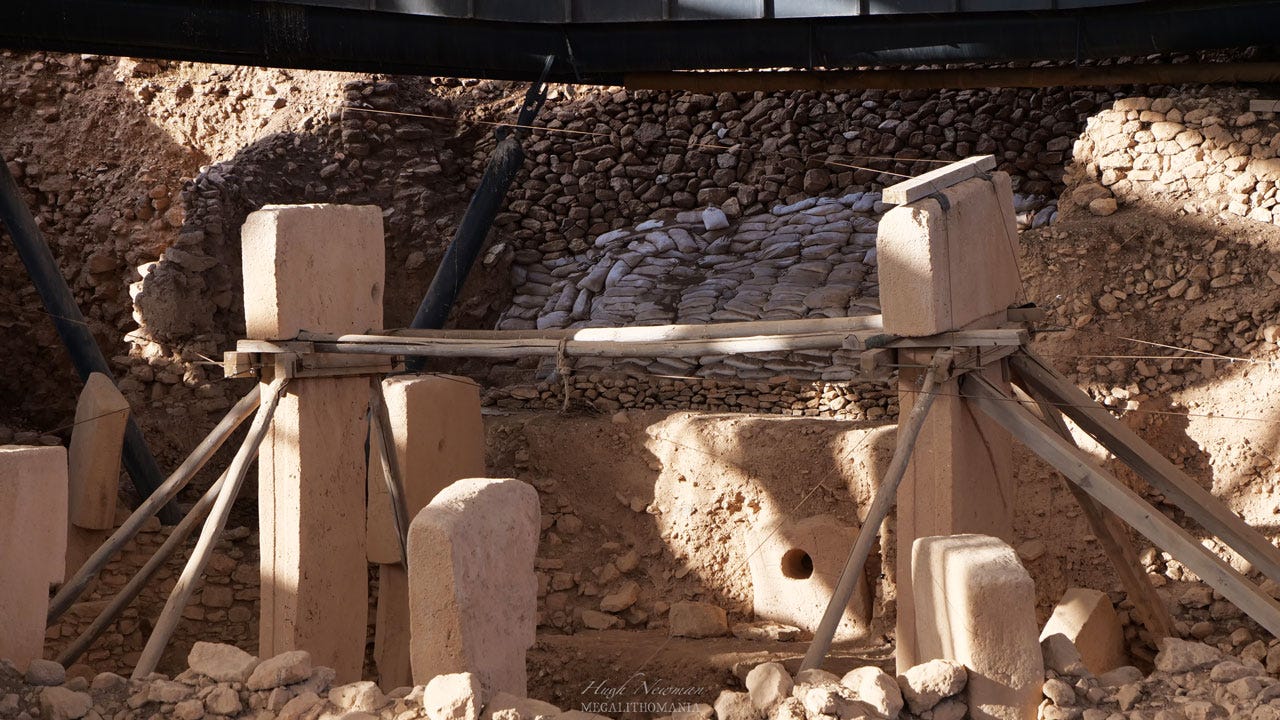
However, we are open to the idea of this type of discussion as non-permanent roofs may well have been used, or even lighter configurations that do not destabilise the central T-pillars. We wondered if these or any other solutions could incorporate both roofs and astronomical alignments together?
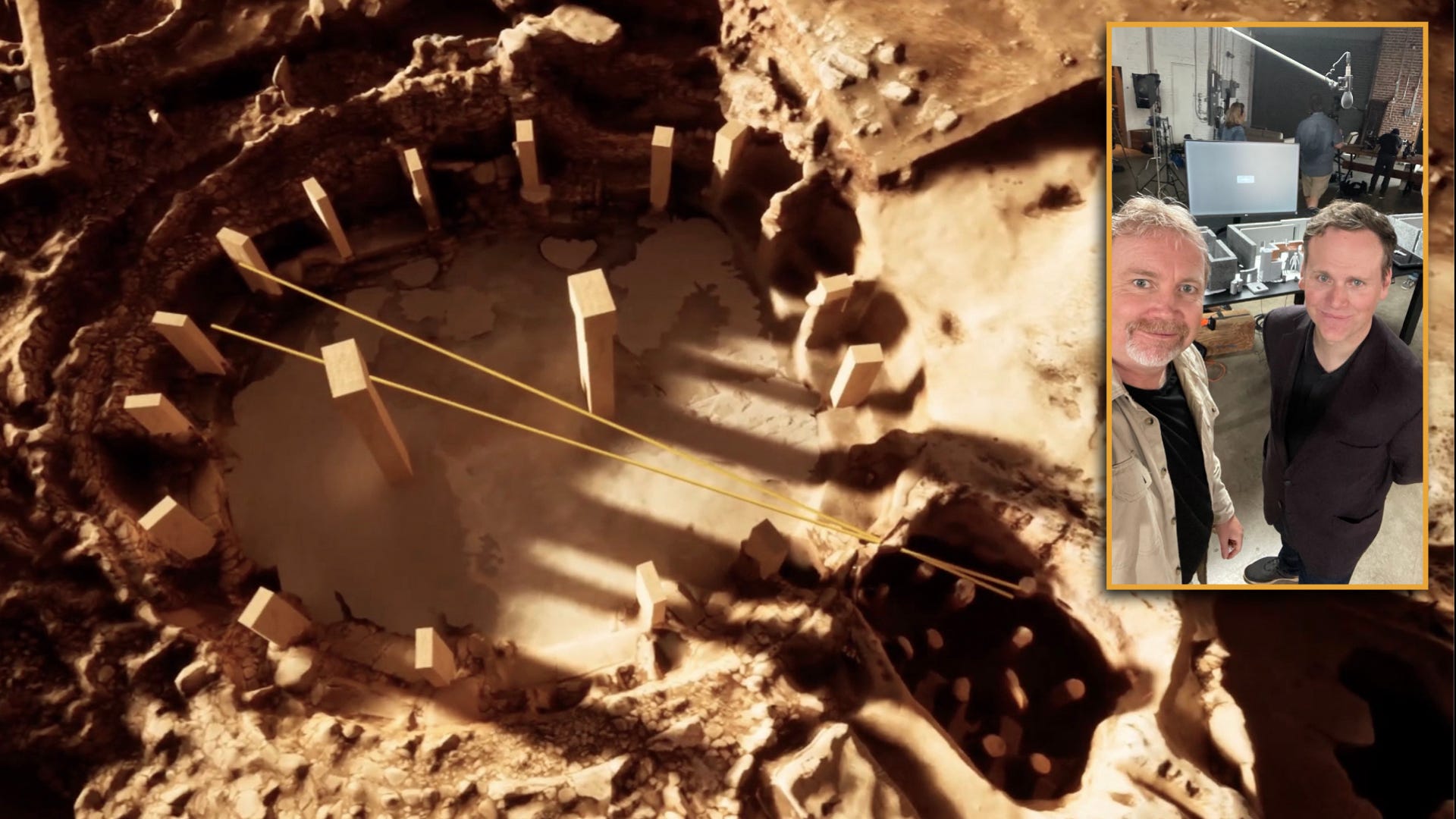
Matt Sibson, who runs the Ancient Architects Youtube channel,14 worked alongside graphic 3D artist Kevin Eslinger to create a hypothetical roof over Structure AD at Karahan Tepe, as he (along with Martin Sweatman) believed a roof would block this view of the sunrise on the winter solstice.
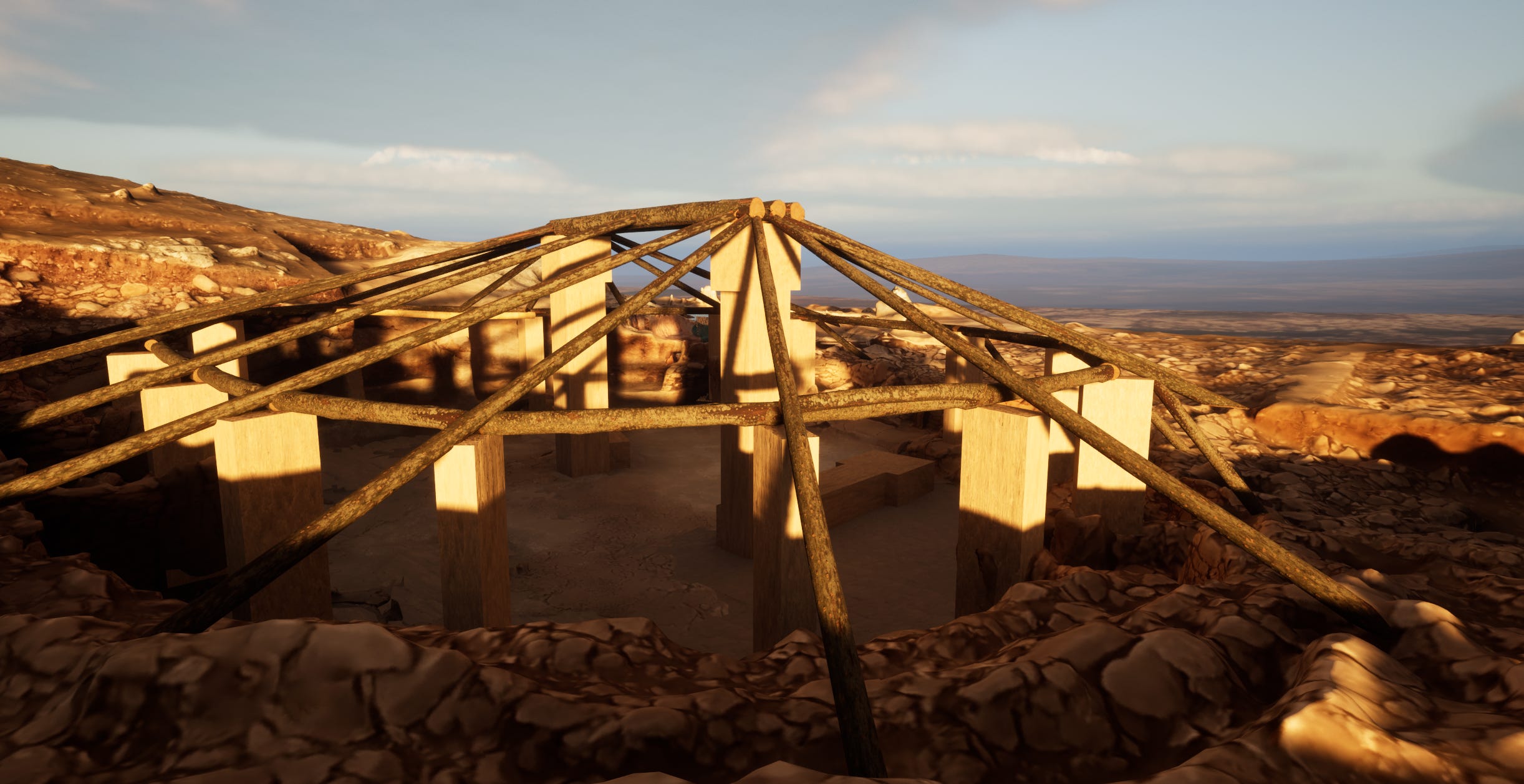
Eslinger went ahead and reconstructed a roof with our assistance and what he quickly realised was, based upon studying Native American roofs that had similar structural designs, is that there were likely to be openings between the outer T-pillars, to create ‘windows’ to allow light in.15 He then placed the sky from 9000 BC (using Stellarium with precise data from the authors), and after creating the roof and all the wooden beams in 3D concluded that the winter solstice sunrise alignment works with a roof, with a perfect ‘gap’ between two T-pillars in the outer circle (and a section above this in the roof), and the two central T-pillars to allow the light through.
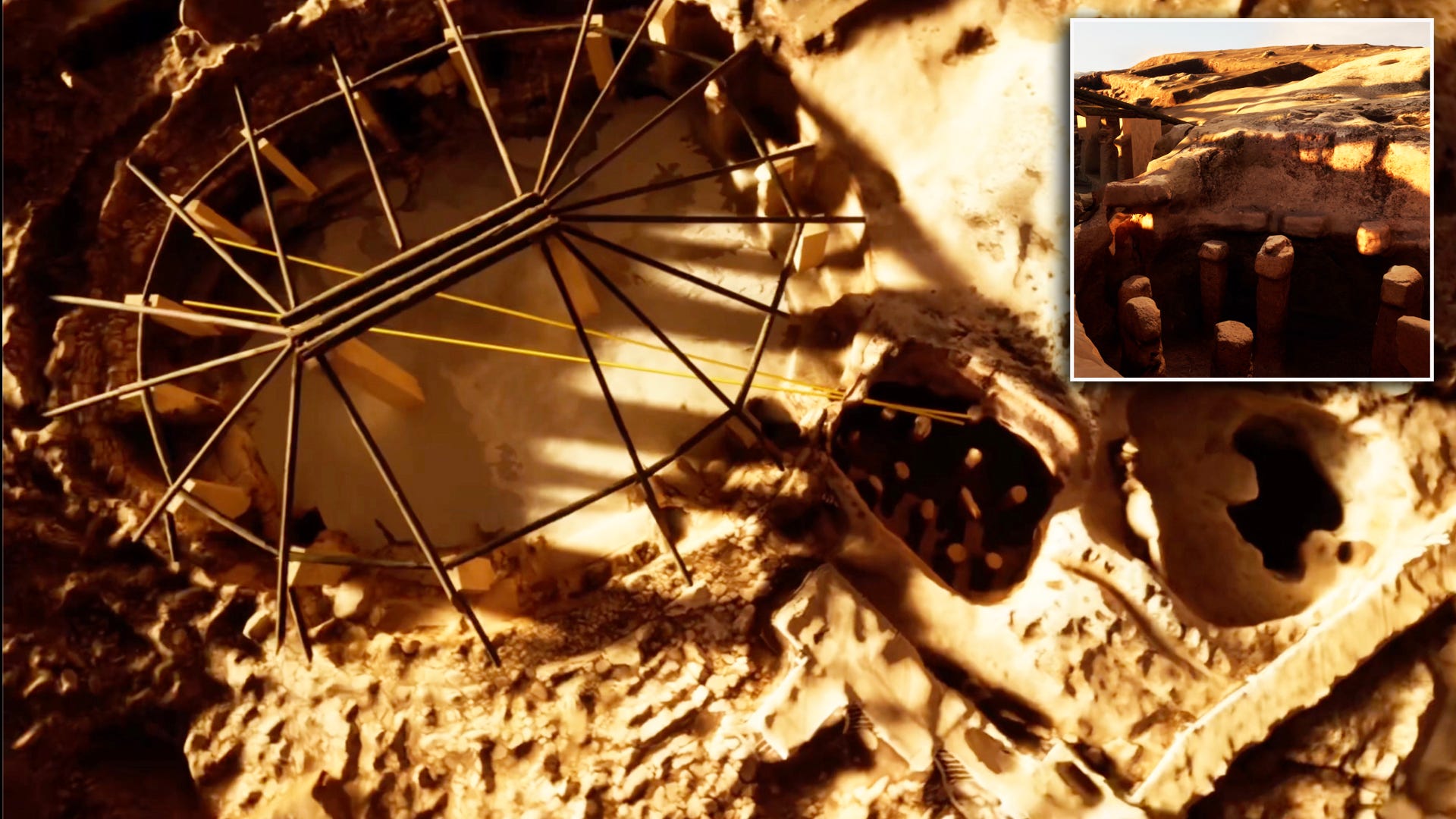
Eslinger originally set out to disprove the winter solstice alignment but was surprised by his findings. Even after this analysis which was tested by various configurations and placements of the wooden beam and covering, it still worked, even with a complete ‘thatch’ covering based upon traditional Pawnee Native American techniques.16 After some discussion with them both we received a private email from Matt Sibson in which he stated:
“Kevin Eslinger sent me some screenshots of his most recent solstice alignments - with your adjustments - with the Karahan face - and wow! And the wooden posts added to the structure don’t obstruct it. So it means there could be a compromise. The roof of the enclosure could be more like a football stadium - with the perimeter benches covered but the middle section open to the elements. This would allow for your solstice alignment, AND would give a structural explanation for the pillars.”
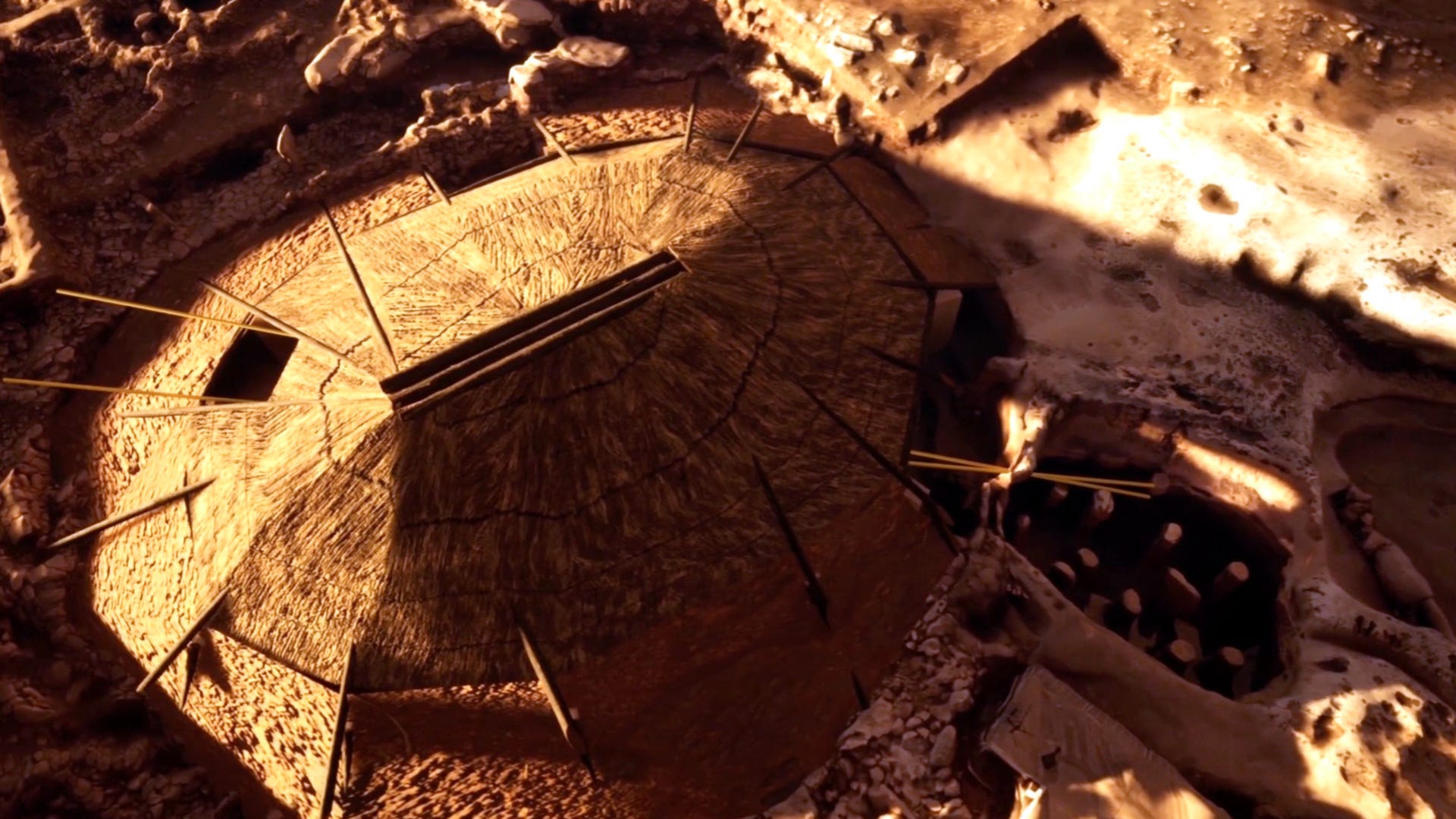
A hypothetical solution had been revealed that went along with traditional Pawnee techniques of construction and integrated the winter solstice alignment. Although these findings support the midwinter alignment we must remember that still no wood has been found at Karahan Tepe (or wooden beam negatives) and the structural integrity of the T-pillars is still in question according to Daniel Matthies and Remi Haddad. However, it does prove that the winter solstice alignment is valid with or without a roof. Experimenting and reconstructing a possible roof has become a fascinating project in its own right, but it is now clear that investigating solar, lunar and star alignments should be just as important to explore, as the two can now apparently easily co-exist.
Eslinger stated: “Architecturally, there are intriguing parallels between the Pawnee and the builders of Karahan Tepe and Göbekli Tepe. The Pawnee constructed dome-shaped earthen homes with central holes in the roof, which served dual purposes: structural ventilation and astronomical observation. These holes allowed light beams to enter the interior, marking specific points throughout the year, such as the winter solstice.” He concluded by saying: “I believe that the play of light on the face found at Karahan Tepe was absolutely used to indicate the winter solstice to the community living there.”

The 3D modelling demonstrates that the illumination remains viable under multiple plausible roofing configurations. Partial roofing with peripheral openings or central apertures allows the solar beam to pass between outer and central pillars before entering the porthole. Even under more extensive thatch-style roofing models, controlled gaps aligned with the solstitial sunrise permit illumination of the stone head. These results indicate that the alignment is not dependent on a fully open structure.
Perhaps it is now time for the academic establishment to look to the skies once more, just like our ancestors did, as it is now beyond doubt that astronomy played a part in the mindset of the Taş Tepeler people whether roofs covered parts of the sites or not.
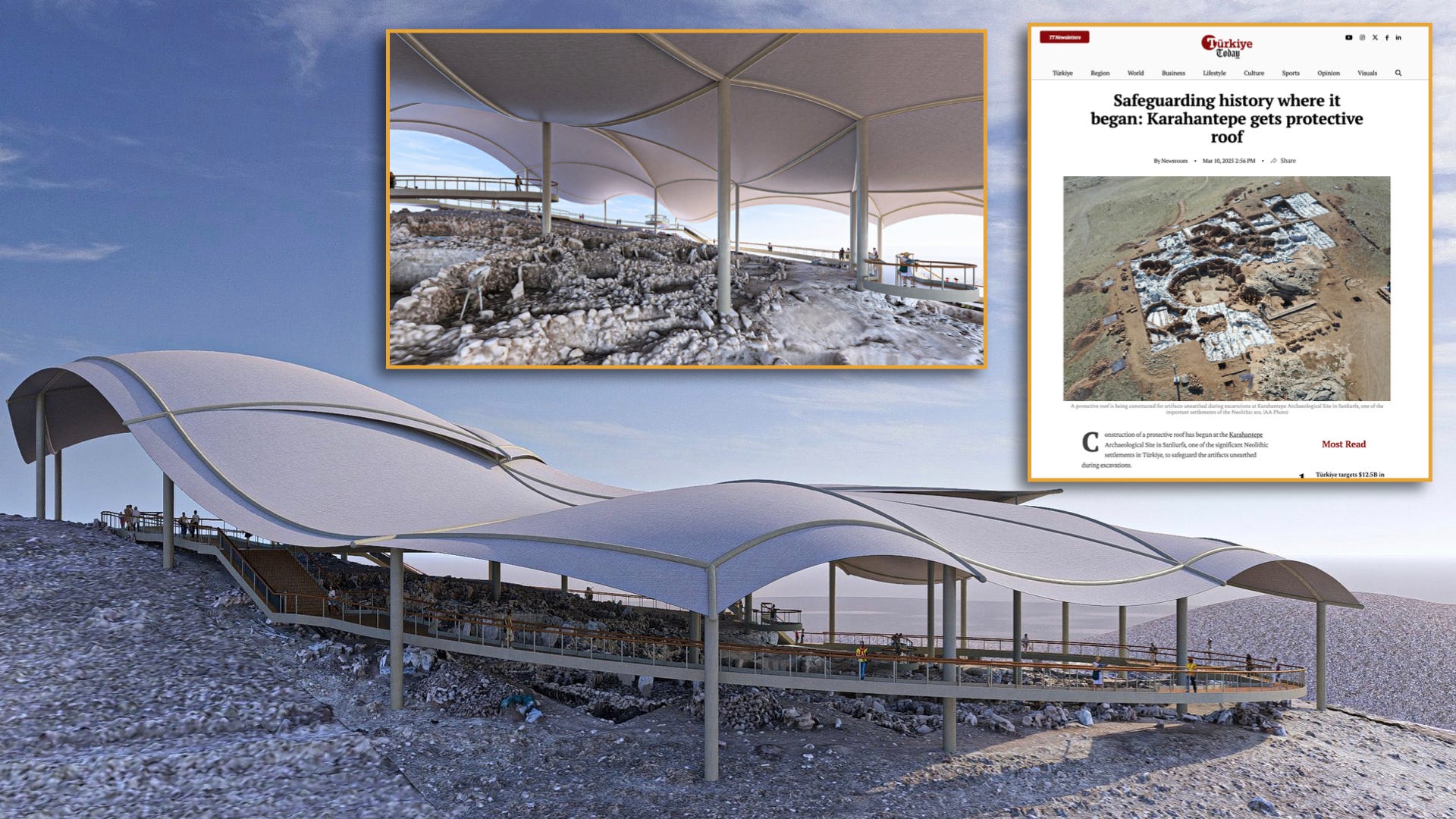
Another concern is the plan for a new roof to be built in 2026 to protect the site. This could block the phenomenon for good, so we urge the archaeologists at the site to allow archaeoastronomers to make relevant observations and calculations before this happens. To obscure a potential solstitial alignment without proper study would be to erase a chapter of human history before it has been read. We also request that the winter solstice sunrise should still be able to be viewed as part of the new design, with a notable gap in the new covering, so that future generations can continue to witness it, and even celebrate it, just like the people of Karahan Tepe once did.
Earlier versions of this article featured on Academia in December 2024 and Ancient Origins Premium in November 2025.
Copyright Hugh Newman and JJ Ainsworth 2024-2025. The authors would like to thank Kevin Eslinger, Andrew Collins, Matt Sibson, Dr. Martin Sweatman, Daniel Matthies and Dan Lish for their assistance with this article.
References:
Hugh Newman and JJ Ainsworth. Karahan Tepe: Stunning New Discovery of Winter Solstice Sunrise Alignment. https://www.ancient-origins.net/news-history-archaeology/karahan-tepe-winter-solstice-0016212
Prof. Necmi Karul quoted in Debunking claims about Gobeklitepe, By Koray Erdogan. 2024. www.turkiyetoday.com/culture/debunking-claims-gobeklitepe-75895/
Hugh Newman and JJ Ainsworth. Appendix 1 in Karahan Tepe: Civilization of the Anunnaki and the Cosmic Origins of the Serpent of Eden, Andrew Collins. 2024. Inner Traditions, USA. www.innertraditions.com/karahan-tepe
Prof. Necmi Karul. Buried Buildings at Pre-Pottery Neolithic Karahantepe. 2021. Türk Arkeoloji ve Etnografya Dergisi. p.82
Graham Hancock interviewing Necmi Karul inside the Pillars Shrine on Ancient Apocalypse, Episode 5, ‘Legacy of the Sages’, Netflix, 2022
Martin B. Sweatman. Representations of calendars and time at Göbekli Tepe and Karahan Tepe support an astronomical interpretation of their symbolism, 2022-2024. www.doi.org/10.1080/1751696X.2024.2373876
Prof. Necmi Karul quoted in Debunking claims about Gobeklitepe, By Koray Erdogan. 2024. www.turkiyetoday.com/culture/debunking-claims-gobeklitepe-75895/
Dr. Lee Clare. Inspired individuals and charismatic leaders: Hunter-gatherer crisis and the rise and fall of invisible decision-makers at Göbeklitepe. 2024. https://doi.org/10.4312/dp.51.16
Sarah Ewbank’s Stonehenge Roof Theory - https://stonehengeroof.uk/
E. B. Banning. So Fair a House: Gobekli Tepe and the Identification of Temples in the Pre-Pottery Neolithic of the Near East, Current AnthropologyVolume 52, Number 5. 2011. www.journals.uchicago.edu/doi/10.1086/661207
Rémi Hadad, In the shadow of monoliths. Göbekli Tepe and the monumental tradition of the Pre-Pottery Levant, in Luc LAPORTE et.al. Eds., Megaliths of the World: Volume 1, ArchaeoPress, Oxford, 2022, p.833
Ibid. Image drawn and co-designed by Michael Chomette, p.834, adapted and coloured by Hugh Newman
Karahan Tepe Roof Reconstruction, video by Kevin Eslinger.
First presented in: Karahan Tepe: Earliest Winter Solstice Alignment c.9400BC. Video.
Just question isn’t the mouth of humans usually shut ? unless eating, speaking, other activities, the mouth only falls open in death, and must be held shut in some way or manner. If this paper was written based upon lunar calendar, and the pagan belief thoughts, I have more questions around the mouth being open, and the idea of Summer Solstice versus Winter Solstice. As in the lunar calendar, winter solstice is are the earth, humans being quiet, and death, versus Summer Solstice which birth and life. And actually how the mouth works in humans.
Eslinger's design has no structure integrity. The roof rafters will slip or roll off the main T pillars.